 |
|
|
| |
| - | | | | - | | - | | - | | - | | | | - | | - | | - | | - | | - | | - | | - | | - | | | | - | | - | | - | | | | - | | - | | - | | - | | | | - | | - | | | | - | | - | | | | - | | - | | - | | - | | - | | - | | - | | | | - | | - | | - | | - | | | | - | | - | | - | | | | - | | - | | | | - | | - | | | | - | | - | | - | | - | | - | | - | | - | | | | - | | - | | | | - | | - | | - | | - | | - | | - | | - | | | | - | | - | | - | | - | | - | | - | | - | | - | | | | - | | - |
| |
|
|
|
- Ordering Info / Terms
|
|
-
|
|
-
|
|
-
|
|
-
|
|
-
|
| |
|
|
|
-
|
|
-
|
| |
|
|
|
-
|
|
|
|
|
HOMEPAGE VISIT OUR ONLINE COMMUNITY PRODUCT SEARCH

The Law
You do not need a license to own any of the products we are actually selling on the website, they are also all legal to own in the U.K
By law you must be 18 or over to purchase a knife/sword. We age verify all orders, even those placed with Visa or Mastercard Credit Cards (as both are now offered to under 18's in prepaid cards), so please make our lives a little easier and fill in all the forms on the checkout page, especially the contact numbers section as we will inevitably need to call some customers to assist with verifying age of the purchaser where background checks have failed. We would also hope you will act responsibly with your new purchase and it is a condition of purchase that you will NEVER CARRY IT IN A PUBLIC PLACE. By purchasing from this site you are commiting yourself to our terms and conditions.
Illegal GoodsSamurai and other curved Swords - On April 6th 2008 a law came into effect banning samurai and other curved swords with a blade length of 50cm or more, there are some exceptions for registered martial artists, re-enactors and even certain genuine Japanese swords.
An amendment to this act was passed, which came into effect on the 1st of August 2008, which allows curved and samurai swords which are handmade using traditional forging/production methods to be sold without a license which you will see on the site and can buy and own without a license.
We also sell handmade swords which, in our expert opinion, meet the definition set out in the amendment, but, according to the home office, were not really intended to. As a responsible retailer we have restricted their sale to martial artists, to prevent online sales they are listed as restricted and you will not be able to purchase one without first supplying us with a copy of a valid club membership or other defence as specified in law.
Some controversial legislation was passed in 1988 which made certain types of knives illegal to import or sell in the U.K, these include push daggers, butterfly knives, blowpipes, sword canes, gravity knives (similar to flick knives), knuckle dusters (inc. knives and other weapons with knuckle duster style handles), throwing stars (with 3 or more spikes) and some martial arts equipment, we will not source these items for you so please don't ask. For a more detailed breakdown you can view 'The Criminal Justice Act 1988 (Offensive Weapons)' by clicking
OFFENSIVE WEAPONS ACT
.
If you should attempt to import prohibited goods you will probably be unsuccessful and leave yourself open to various avenues of police action, at the very least your consignment will be confiscated and you will recieve a letter like this (kindly supplied by one of our new customers) Notice Of Seizure
Blade Material
The blades come in various types as far as metals go, here's a break down;
420 J2 - this is top quality stainless steel, it's a precision metal and can be incredibly well polished, also it won't rust or stain. It's often refered to as a 'surgical steel' as it's the same metal used for surgical knives and instruments.
440 C - is also a stainless steel and a very robust metal, this is used in some of the cheaper functional items and in several of the decorative pieces.
Carbon Steel - this is simply the strongest stuff you can get and it don't come cheap. It's very important if you buy a carbon steel blade that you keep it protected from ther air (oil will provide a barrier) as it will oxidise rust if left in contact with oxygen. All carbon steel blades arrive to you oiled, there are various different 'styles' of carbon steel. The best being High Spring Carbon Steel and Damascus Carbon Steel
Folded versus Forged Carbon Steel Blades
Originally the point of folding was to spread the carbon content out evenly along the blade and remove impurities, otherwise you would have soft and hard spots, and the blade would often break in these places. Modern steel is of a lot better quality and already has an evenly distributed carbon content, so there is no need for folding to improve strength if the blade is forged correctly (this is a heat-treatment process). Our forged blades start from �110, a massive saving over a folded blade but are just as strong and 'real', however, you cannot beat the beauty of a folded blade.
A word on Tangs
A tang is the method used to attach the blade to the handle. There are various types of tang and the one for your particular sword will usually be determined by it's intended purpose.
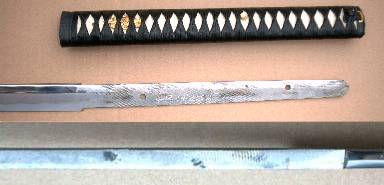
A full tang is where the blade runs the full length of the sword and the handle is literally bolted onto the blade. These are incredibly strong and you will find almost all functional or 'Battle-Ready' pieces will have a full or traditional tang (full tang is a term that would not be applied to all sword types).
Here's a picture of the Practical plus katana which sports a full-tang
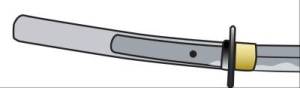
A push tang is where the blade is pushed halfway into the handle and fixed in place. It's fairly strong but not functional, it's mostly used for strong decorative pieces.
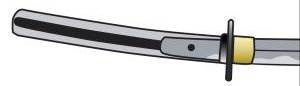
A rat-tail tang is where the blade comes to an abrupt end just inside the handle, it's then welded onto a circluar piece of metal which runs the length of the handle. they are for display swords only
Hardness of Carbon Steel
In some sword sections on this site you may see notes in the descriptions with figures on the steel such as R40, R60. These refer to hardness of steel which is measured by units called "Rockwell's" on a scale known as the Rockwell C scale (RC). The higher the Rockwell value the harder the metal is, the higher the number does not relate to how good the sword is. Some blades need to be flexible and have different properties and many are made of more than one hardness of steel such as the forged and folded blades we sell. Here are some RC values and explanations about them.
" 20-25 RC - Mild Steel - At this level of hardness steel bars can flex a few inches and return to their original shape. Anything heat treated higher than 25 can cut into mild steel (in the right tool, not a sword!)
" 30-40 RC - This level of hardness is the lowest RC you allow for a sword. Swords recklessly exposed to incorrect edge-on-edge fighting will dent but not chip and can be hammered back straight at 40 rc.
" 40-45 RC - This is a good RC to be used on the spine (back of the blade) of differentially heat-treated swords (e.g. Chinese, Japanese, etc.) This hardness level will have some spring qualities, allowing the blade to flex slightly and therefore absorb the impact of the collision.
" 50-52 RC - This is the base for the European style and medieval swords. Buying a sword or knife at this hardness will give you a good middle-line between hardness for holding an edge and toughness. It's still soft enough though to be a good shock absorber dampening vibrations passed thought the blade to the tang then to your hands.
" 58-60 RC - This is the ideal hardness for the edge of differentially heat treated swords like Japanese katanas and Chinese swords. An edge of this hardness can slice into most materials that are comparably softer like some woods and plastics (again, only in the right tool for the task)
Order Questions
If you failed to recieve a e-mail confirmation within one hour of ordering, don't worry, you should recieve the worldpay payment mail and we'll be in touch within in the next 72 hours with a delivery date.
Issue Numbers - Your card only has an issue number if this is printed on the front of the card itself, if not, leave that section blank as it will cause your card to be declined for payment.
Sword Parts
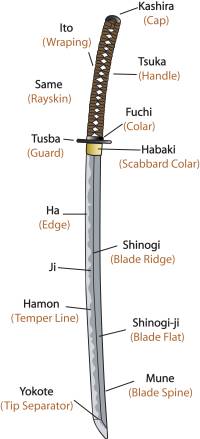
My functional sword ins't razor sharp?
Good!, that's exactly how it's meant to be. The fantasy that how well a sword cuts is purely based on it's sharpness is one that is widespread among novices and totally inaccurate. Skill, Practice, Balance and Training are what determines how well a sword will cut.
The functional swords are sharpened to exact degree they need to be for their intended purpose. To razor sharpen a blade will take it to such a fine edge that it will be brittle and prone to chipping, particularly when you consider the forces involved when a blade swung at full force will come under when it meets it's target. Even a sword that does not feel very sharp will still perform well, a good example to show this is to hold a piece of A4 paper and watch the blade slice this neatly in half (though a little practice might be required to do it perfectly everytime)
|
All prices include VAT at the current rate, Vat Reg No. GB803248258
Wholesale Trade Enquiries Welcome wholesale details
This site was designed & coded by Lee Conlin for Blades UK
PHP Code Copyright © Lee Conlin 2002-2020, IMAGES copyright © Blades UK - we will pursue image theft through our copyright solicitors (lawdit)
Logos and Trademarks are the property of their owners. The Co. name Blades UK is protected by law
|